Chin liposuction complications and revision
What unwanted results are reported after chin liposuction?
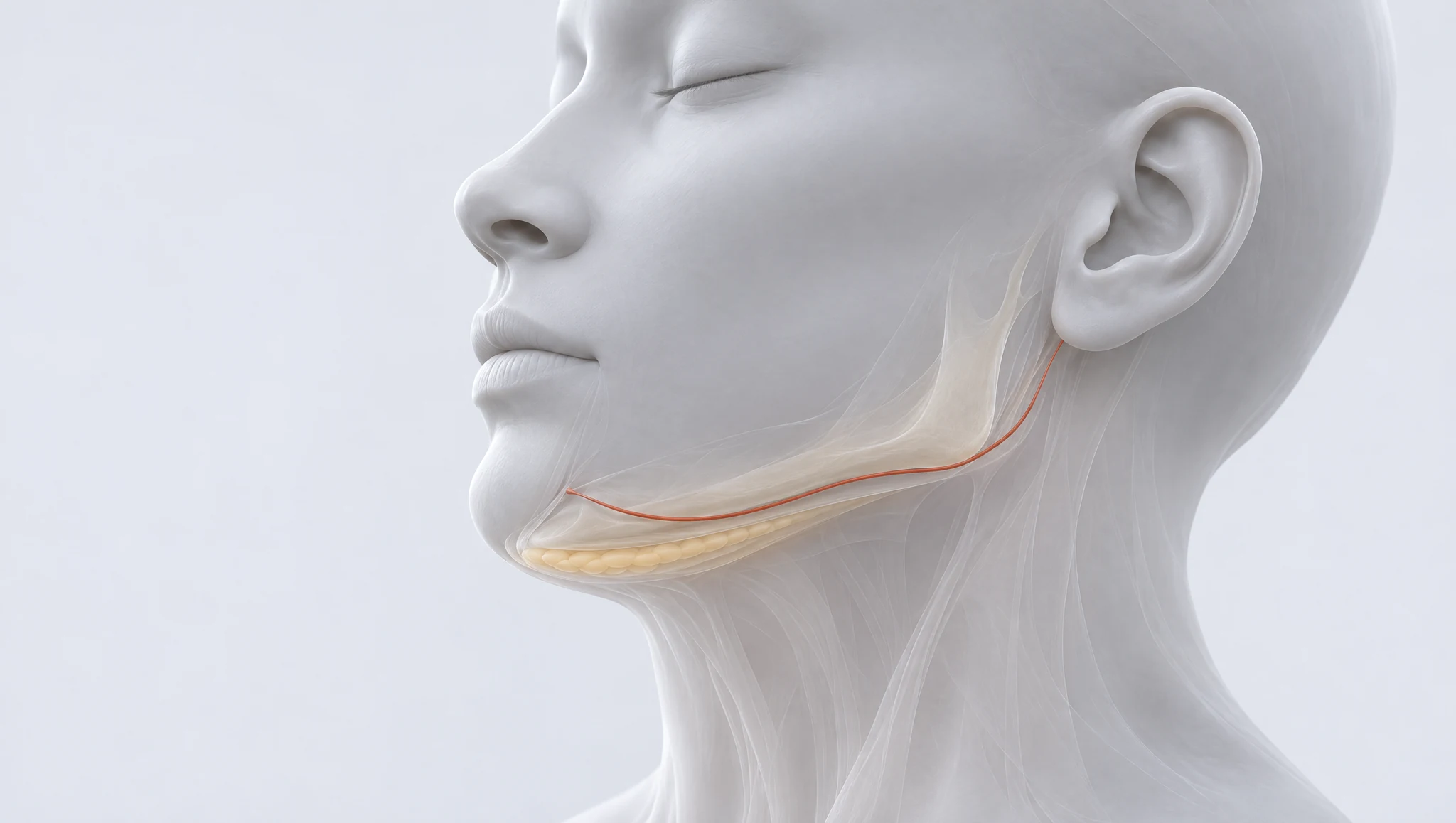
After chin liposuction, reported problems include seroma, irregularity or asymmetry, residual bands or loose skin and temporary nerve weakness. A systematic review of 2,085 submental (under-chin) liposuction procedures in adults found 270 reported adverse events, or 12.9 events per 100 procedures. Of those events, 74.8% were minor.[1][2]
Written by the Double Chin Seoul editorial team from the sources listed on each page. Last updated: .
Which complications are reported after chin liposuction?
This 2026 systematic review drew on 13 studies, limited to case reports and case series, and the authors noted the limits of that evidence.[1]
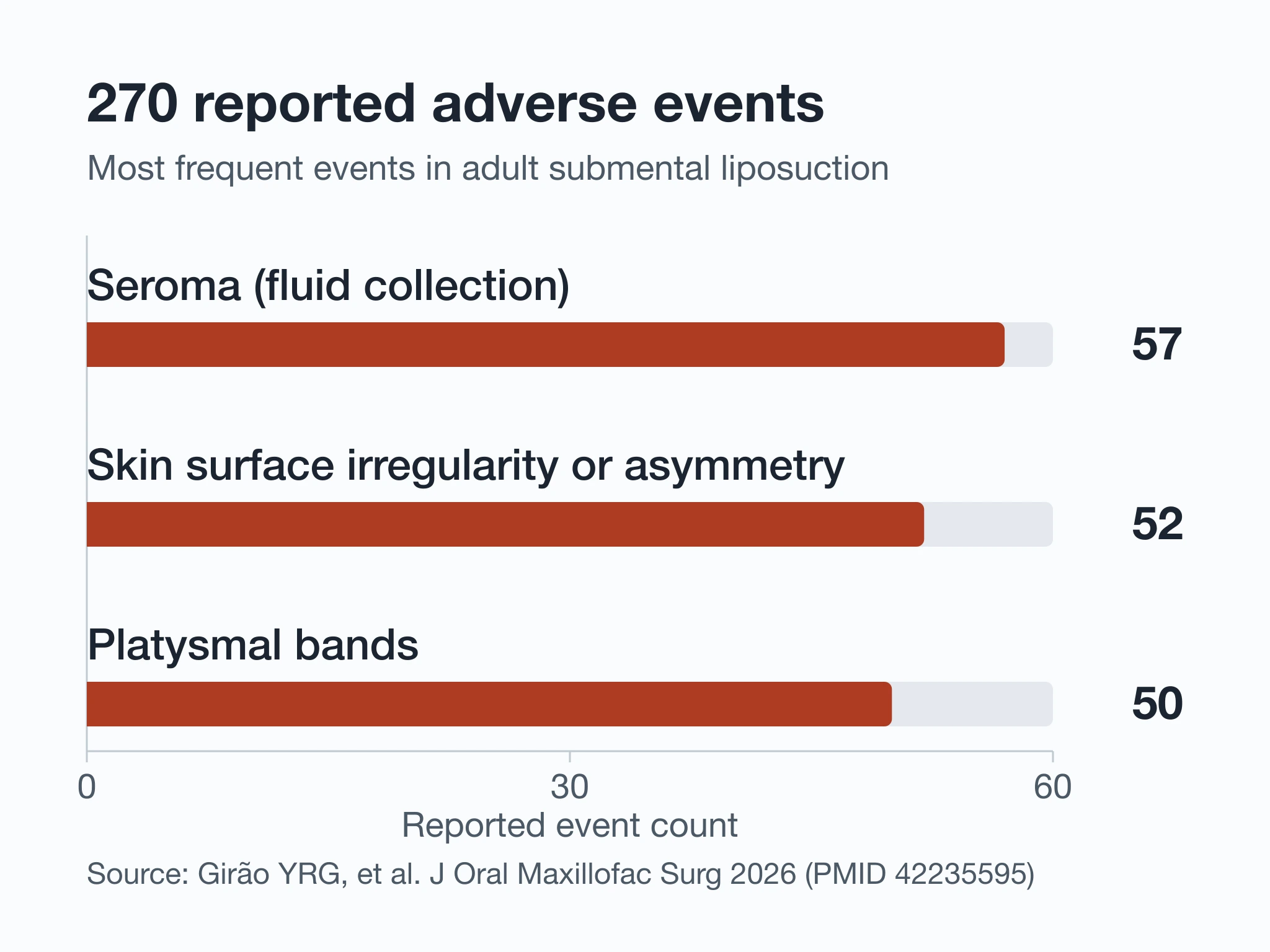
Most of the minor adverse events could be managed in outpatient settings.[1]
| Type | Reported events |
|---|---|
| Seroma (fluid collection) | 57 |
| Skin surface irregularity or asymmetry | 52 |
| Platysmal bands (vertical neck bands) | 50 |
A separate scoping review listed submental depression, swelling, hypertrophic scarring, scar contracture and temporary facial nerve paralysis among the reported complications.[3]
How does firmness after chin liposuction change over time?
For a while after liposuction, the tissue under the skin can feel firm or tight. This is different from scar contracture, in which a scar itself shortens.
Lasting firmness is different: in a study of ultrasound-assisted neck liposuction with 435 participants, fibrosis, which leaves the tissue firm, and asymmetry were reported in 3 cases (0.69%).[2]
In a study of 66 East Asian patients treated with radiofrequency-assisted liposuction, nodules were reported in five.[4]
In the systematic review, adverse events appeared a mean of 1.7 months after surgery (widely varying, standard deviation 3.2 months); median follow-up was 10 months. Judge the result on more than early firmness and keep follow-up visits.[1]
Why do irregularity and over-resection happen?
Chin liposuction does not remove every trace of fat. An even layer is kept between the skin and the platysma to shape the contour.[5]
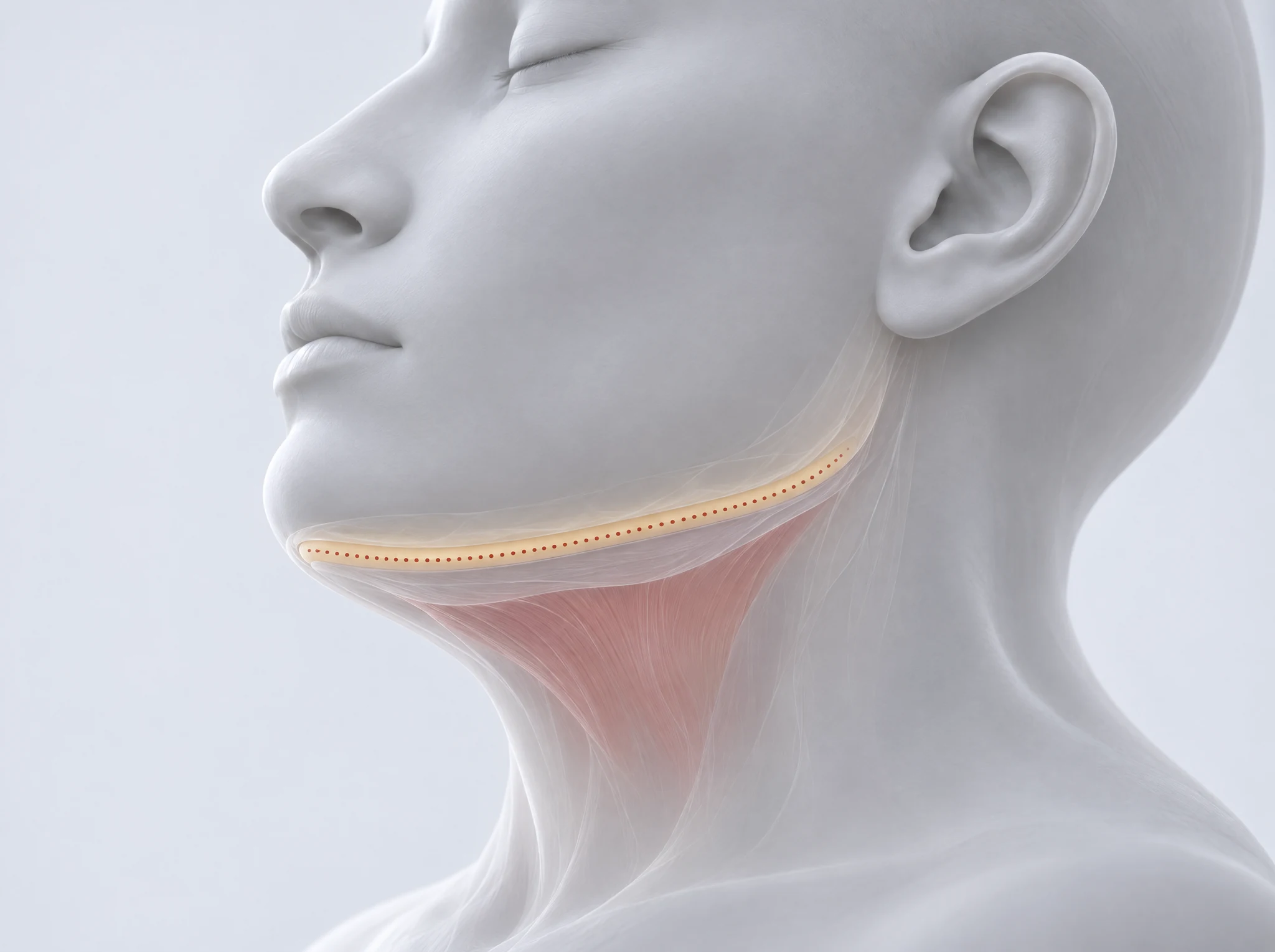
The scoping review explains that removing too much fat beneath the platysma lets the submental skin adhere to the deeper mylohyoid muscle, which can leave a depression or deformity.[3]
The treated area and the thickness left behind are decided with the surgeon before surgery. Extending from under the chin to the jawline also changes the entry points, so check the area and entry points for chin liposuction.[5]
Why can loose skin or neck bands remain after fat removal?
Liposuction reduces fat under the skin. It does not stitch the platysma together or remove excess skin.[5][6]
In the systematic review, platysmal bands were also among the most frequent adverse events. In the ultrasound-assisted study, skin laxity was noted in 1 of 435 participants (0.23%).[1][2]
If muscle, skin or jaw shape also contributes to the fullness, start with choosing surgery by cause.
Which changes are temporary, and when is revision discussed?
In the ultrasound-assisted study, four patients (0.91%) had injury to the marginal mandibular nerve, which controls lower-lip movement, and all four recovered.[2]
In a report of 85 patients who had liposuction combined with platysma surgery, three developed seromas that were treated with needle aspiration.[7]
In a systematic review of revision neck lifts (5 retrospective series, 188 cases), recurrent platysmal bands, persistent submental fullness and submandibular gland ptosis were the most frequently cited reasons.[8]
The same review includes a report of second submental operations performed 6–18 months after the first, for recurrent neck laxity and an inadequate submental contour.[8]
What should you decide and ask before surgery?
Neck liposuction and submentoplasty are smaller operations than a facelift, but they have many pitfalls, and patient selection and choosing the correct operation are crucial.[9]
If you’re also considering surgery to tighten the neck muscle, read about the risks of platysmaplasty and ask which risks apply to your planned operation and how they would be managed.
How will the treated area and the fat left in place be decided?
Why it matters. It shows how the plan avoids irregularity and over-resection.
What a good answer includes. The surgeon separates the area under the chin from the jawline and explains keeping a layer of fat under the skin.
Treat with caution. The only explanation is that as much fat as possible will be removed.
Besides fat, does the muscle or skin need treatment?
Why it matters. It tells you before surgery what liposuction alone will not change.
What a good answer includes. The surgeon examines neck bands and skin recoil and explains each task separately.
Treat with caution. Every double chin is described as fixable with liposuction alone.
Who will examine firmness or irregularity after surgery, and when?
Why it matters. You need a way to report progress after returning home.
What a good answer includes. You receive follow-up dates and a contact for reporting progress from home.
Treat with caution. When you ask about contact after returning home, no specific channel is named.
Common questions
How often does chin liposuction go wrong?
A systematic review of 2,085 submental (under-chin) liposuction procedures in adults found 270 reported adverse events, or 12.9 events per 100 procedures. Of the reported events, 74.8% were minor. The figures count events in case reports and case series. Estimating a patient’s risk would require knowing how many people had at least one event.[1]
What does firmness after chin liposuction mean?
It refers to the tissue under the skin feeling firm or tight for a while after surgery. Lasting firmness from fibrosis is different: in the ultrasound-assisted study, fibrosis and asymmetry were reported in 3 of 435 participants.[2]
Can loose skin remain after chin liposuction?
Liposuction does not remove skin, so skin recoil is checked before surgery. In the ultrasound-assisted study, skin laxity was noted in 1 of 435 participants.[5][2]
Can chin liposuction be revised if I regret it?
Revision surgery is reported. In a systematic review of revision neck lifts, complications were uncommon and mainly transient, but aesthetic outcomes were mostly qualitative and surgeon-reported.[8]
References
(9)
Bibliographic records retrieved from PubMed (U.S. National Library of Medicine).
Girão YRG, Soares AC, Costa FWG, et al. Adverse Events Related to Submental Aesthetic Liposuction: A Systematic Review. J Oral Maxillofac Surg. 2026 May 22 [online ahead of print].
AlQhtani A, AlSahabi A. Five Steps for Effective Office-Based Neck Ultrasound-Assisted Liposuction Under Local Anesthesia: Patient Outcomes. Aesthetic Plast Surg. 2026;50(9):3185-3192.
Diniz DA, Gonçalves KK, Silva CC, et al. Complications associated with submental liposuction: a scoping review. Med Oral Patol Oral Cir Bucal. 2022;27(3):e257-e264.
Yen S, Wang J, Gao X, et al. Bipolar Radiofrequency-Assisted Liposuction for Cervical Contouring in Eastern Asians. Aesthet Surg J Open Forum. 2023;5:ojad035.
Mejia JD, Nahai FR, Nahai F, et al. Isolated management of the aging neck. Semin Plast Surg. 2009;23(4):264-73.
Fattahi T. Submental liposuction versus formal cervicoplasty: which one to choose? J Oral Maxillofac Surg. 2012;70(12):2854-8.
Abulafia AJ, Stoppani I, Espinoza Cisneros V, et al. Neck Rejuvenation Without Periauricular Scars. Aesthetic Plast Surg. 2026;50(17):7211-7220.
Şibar S, Erdal AI, Genç G. Revision Neck Lift Surgery: A Systematic Review of Indications, Techniques, and Outcomes. Aesthetic Plast Surg. 2026;50(9):3298-3306.
Koehler J. Complications of neck liposuction and submentoplasty. Oral Maxillofac Surg Clin North Am. 2009;21(1):43-52, vi.